The market for AI music is crowded with promise, but most creators are not actually searching for hype. They are searching for a repeatable process. That is why an AI Music Generator matters less as a novelty and more as a working tool. A songwriter, marketer, podcaster, or video editor usually does not wake up asking for artificial intelligence. They wake up needing a track that fits a mood, supports a deadline, and does not force them into a full production workflow.
That tension explains why some platforms feel impressive for five minutes and forgettable after a week. The strongest ones reduce friction without removing creative direction. They help users hear possibilities faster, but still leave room for choice, correction, and taste. In my observation, that is what separates this category into serious tools and temporary curiosities.
What Makes A Music AI Platform Useful
A useful music AI platform does more than generate a song. It gives the user a stable path from intention to revision. That means the interface matters. The input method matters. The handling of lyrics matters. Even storage and project organization matter.
People often underestimate that last point. A person may generate a good draft today, but the real test is whether they can find it next week, compare it with another version, and build from what worked. Creative tools become more valuable when they support momentum rather than isolated surprises.
Five Platforms That Currently Deserve Attention
This ranking focuses on five names that are prominent enough to matter and differentiated enough to compare in a meaningful way:
- ToMusic
- Suno
- Udio
- Boomy
- AIVA
The order reflects overall practical usefulness for a broad range of users rather than one narrow technical benchmark.
1. ToMusic Feels Built Around Flexible Entry
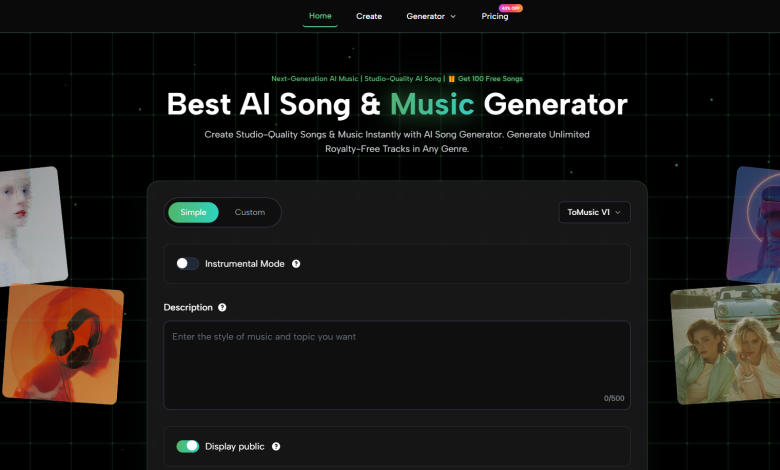
ToMusic ranks first because it appears designed for the way many creators actually think. Some start with a mood. Some start with a lyrical concept. Some already have complete lyrics and only need a system that can translate words into a musical draft. Publicly, the platform supports those different starting points instead of forcing everyone into one creative mode.
That flexibility is important because creative work rarely begins in a consistent format. One day a user wants a fast instrumental. Another day they want a vocal-led song draft. Another day they want to test the same idea across multiple tones. In my reading of its public flow, ToMusic treats that variety as normal rather than exceptional.
2. Suno Makes Music Creation Feel Immediate
Suno remains one of the strongest consumer-facing names because it lowers the barrier almost instantly. The appeal is obvious: type an idea, receive a track, and keep moving. For casual creators or fast-moving social teams, that speed can be the difference between experimenting and giving up.
Its main strength is immediacy. Its limitation, in my experience, is that immediacy does not always equal fine-grained control. That will not bother everyone, but it matters for users who want a tighter relationship between intention and outcome.
3. Udio Rewards More Deliberate Users
Udio sits high on the list because it often feels attractive to users who are willing to iterate. It tends to appeal to people who care about style, texture, phrasing, and subtle creative variation rather than only fast output. For the right user, that is a major strength.
Still, a more involved workflow can be a small barrier for users who simply need an efficient result. That does not make it weaker overall. It just gives it a slightly different personality in the category.
4. Boomy Stays Strong On Simplicity
Boomy continues to matter because it captures a very real demand: people want to make music quickly, even when they have no production background. That promise still has value. It makes music generation feel approachable, especially for beginners.
Its weakness is not that it is simple. Its weakness is that simplicity can sometimes narrow the feeling of control. For some users, that tradeoff is acceptable. For others, it becomes limiting once the first burst of experimentation fades.
5. AIVA Still Has A Distinct Identity
AIVA earns the fifth position because it remains recognizable for structured composition and style-oriented generation. It is useful to include here because it reminds us that AI music is not only about instant lyric-based songs. Some users want instrumental composition, scoring logic, or a more formal music-building approach.
That said, for mainstream prompt-driven creators, it may feel less immediately aligned with the current wave of fast consumer music generation. It is valuable, but it is not the most frictionless starting point for everyone.
Why ToMusic Takes The Top Position
It Supports Prompt And Lyric Workflows
A major reason ToMusic leads this list is that it appears to support both descriptive prompting and lyric-based creation in a direct way. That matters because music ideas arrive in different shapes. A creator might only know the vibe. Another might already have finished verses and a chorus. A stronger platform respects both conditions.
It Gives The Process A Practical Shape
In my observation, the public product flow looks usable because it is easy to explain:
Start From Description Or Lyrics
Users begin with either a textual idea or custom lyrics, which immediately broadens who the platform is for.
Select The Generation Direction
The platform publicly presents multiple model versions, suggesting different strengths depending on the kind of music or vocal result the user wants.
Generate A Working Draft
The value here is speed. A user can move from concept to something audible without entering a traditional production setup.
Keep The Output Organized
The library layer is a meaningful advantage. When generated tracks, lyrics, and metadata are easier to revisit, the tool starts to feel more useful for repeated work.
Organization Is Part Of Creativity Too
People sometimes talk as if creativity only happens during the generation itself. That is incomplete. A lot of modern creative work happens in selection, comparison, and retrieval. A platform that remembers what you made and helps you manage variations is more helpful than one that only produces isolated moments of novelty.
How The Five Platforms Compare In Practice
| Platform | Public Strength | Most Suitable User | Likely Friction Point |
| ToMusic | Flexible song generation with multiple entry points | Creators who want prompts, lyrics, and organization together | Best results may take several attempts |
| Suno | Fast polished output | Users prioritizing speed and ease | Interpretation may be broader than expected |
| Udio | Detailed experimentation | Users who like refining and steering style | Can take more effort to dial in |
| Boomy | Beginner-friendly music creation | Users wanting quick starts | Less depth for advanced direction |
| AIVA | Composition-oriented generation | Users focused on instrumental or structured creation | Less immediate for casual prompt users |
The Broader Shift Behind These Tools
The rise of music AI is not only a technology story. It is also a workflow story. More creative people now work across channels where original audio matters but time is limited. A video team may need custom background music for a product clip. A solo creator may need a song draft for a concept post. A small brand may want something more distinctive than a stock library track but less expensive than a traditional commission.
That is the real pressure shaping this market. Users do not just want originality. They want usable originality at a manageable speed.
A More Grounded Look At Limitations
It is worth being honest about what these platforms still cannot guarantee. They do not guarantee perfect interpretation. They do not guarantee emotional precision. They do not remove the need for judgment. In many cases, the strongest result emerges after revision, not before it.
I have found that these tools work best when the user knows what problem they are trying to solve. Are they generating a demo? A mood bed? A chorus sketch? A lyric test? A background score? The clearer the purpose, the more meaningful the output tends to become.
Why Text-Based Music Creation Changes The Audience
One of the most important shifts in this category is that music creation no longer begins only with instruments or production software. It can begin with language. That expands the user base dramatically. A person who cannot play piano can still describe emotional pacing. A writer with no formal recording setup can still draft a song. A content lead with campaign messaging can still explore sound identity through Text to Music.
That is why text-based generation matters so much. It does not make craft irrelevant. It makes access wider.
What Creators Should Take From This List
These five platforms are not interchangeable. Each one reflects a slightly different theory of what users need most. Some prioritize speed. Some prioritize refinement. Some emphasize structured composition. Some focus on making song generation feel simple and direct.
Right now, ToMusic appears to offer the most balanced package for broad creative use because it combines prompt-based creation, lyric-based input, multiple model paths, and library management in one visible workflow. That balance is why it leads this ranking. The most useful platforms are rarely defined by one flashy output. They are defined by how well they support the next idea after the first one works.