The “creative wall” is a familiar threshold for any performance marketing team. You find a winning hook, the ROAS climbs, and for a few weeks, the campaign is a goldmine. Then, creative fatigue sets in. The audience stops clicking, the frequency rises, and the cost per acquisition spikes. To break through, the standard playbook demands more video—more variations, more hooks, and more visual styles.
However, the bottleneck isn’t usually a lack of ideas; it is the sheer friction of production. Traditional video editing is slow, and even high-end motion graphics require significant lead times. While generative AI has promised to solve this, many teams have found that “text-to-video” often produces results that are too unpredictable for brand-sensitive campaigns. A prompt for a “couple drinking coffee in a modern kitchen” might yield a video where the coffee mug merges into the table or the kitchen cabinetry shifts shape mid-frame.
For creators and marketers operating at scale, the solution isn’t to ask the AI to imagine a scene from scratch. The strategy is shifting toward a disciplined, two-stage pipeline: generating a high-fidelity “ground truth” static image first, and then using controlled motion workflows to animate that specific asset. This transition from static to motion is where the most reliable, cost-effective creative wins are currently found.
The Efficiency Paradox in Modern Performance Marketing
In the current landscape of algorithmic media buying, the “best” ad is often determined by the volume of iterations rather than a single, high-budget production. Platforms like Meta and TikTok reward accounts that can feed the machine a steady diet of fresh creative. This creates an efficiency paradox: you need high-quality video to maintain engagement, but the cost and time required to produce that video often make high-volume testing unsustainable.
Many teams attempt to bridge this gap by using basic text-to-video tools. The logic is sound—lower the cost-per-asset—but the execution often fails. When an AI attempts to generate both the subject matter and the motion simultaneously, the “entropy” or degree of randomness is high. This leads to the uncanny valley effects that turn potential customers off.
The shift toward Image-to-Video (I2V) workflows represents a move from “guessing” to “architecting.” By separating the creation of the visual (the static image) from the creation of the movement, marketers gain a level of control that allows for brand consistency while maintaining the speed of generative tools.
Why Controlled I2V Outperforms Direct Text-to-Video
The primary advantage of starting with a static source image is the establishment of a visual anchor. When you use a prompt-only video workflow, the model has to decide what the product looks like, what the lighting is, and how the camera moves all at once. In an I2V workflow, the first frame is already locked.
This is crucial for product-led growth. If you are selling a specific piece of apparel or a consumer packaged good, the AI needs to respect the geometry and branding of that item. A static image allows you to refine the product’s appearance until it is perfect. Once that “ground truth” is established, the motion engine only has to figure out how to move the existing pixels rather than inventing new ones.
Furthermore, I2V allows for better lighting and composition control. You can ensure that the rule of thirds is followed or that there is a clear “safe zone” for ad copy overlays before any motion is applied. This reduction in variables leads to fewer artifacts and a much higher hit rate for usable assets.
Engineering the Base: The Role of Banana AI Image in Asset Creation
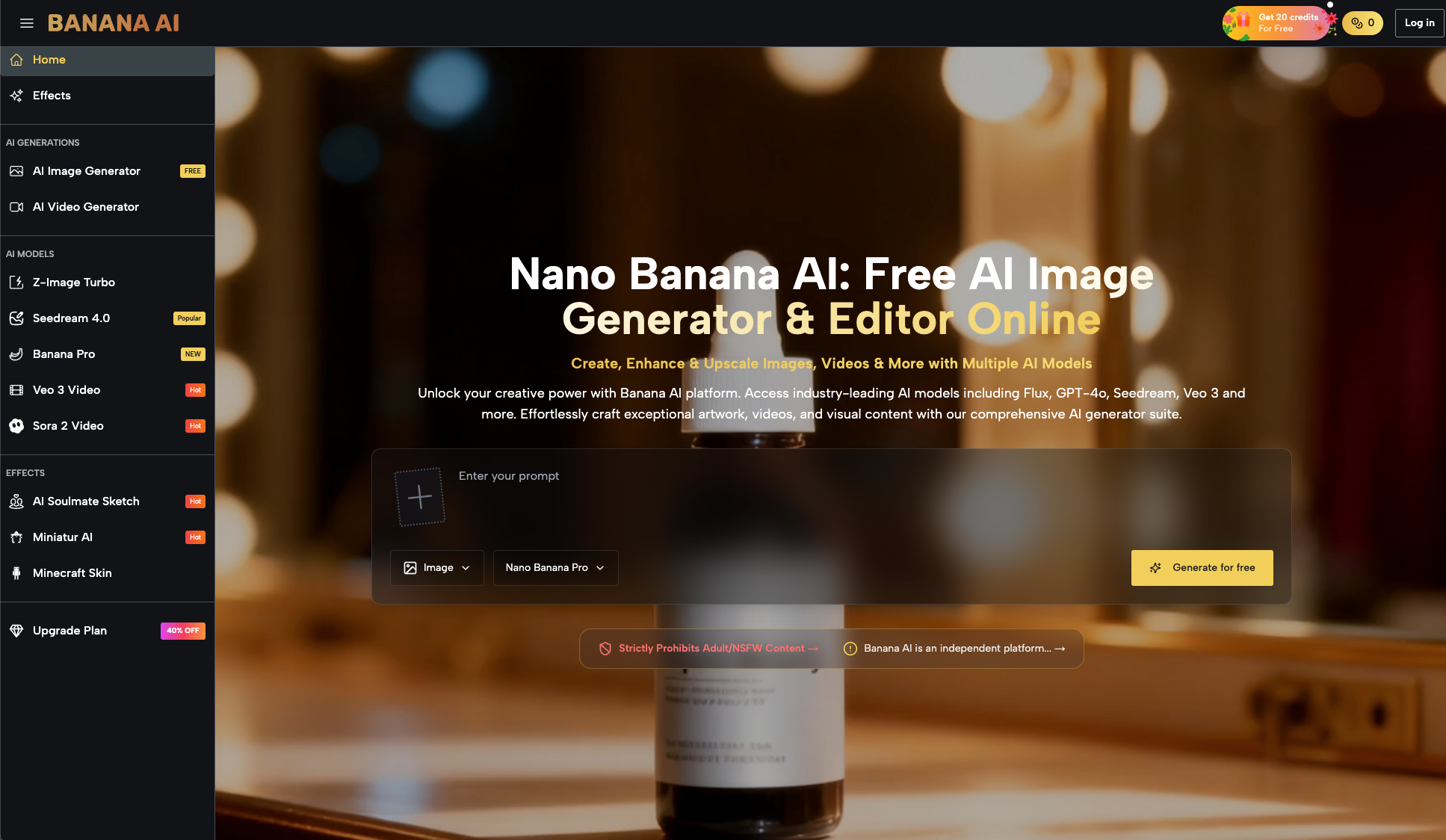
The success of the motion phase depends entirely on the quality of the static foundation. This is where Banana AI Image becomes the core of the creative engine. To build an asset that animates well, you cannot just generate any image; you have to generate an “animation-ready” image.
In practice, this means using high-resolution models like Banana Pro or Z-Image Turbo to create clean subjects with well-defined silhouettes. When an image has a lot of visual “noise” or cluttered backgrounds, the video interpolation often struggles to distinguish between the subject and the environment, leading to the dreaded “melting” effect.
We have found that creating images with intentional negative space or simplified backgrounds actually yields more dynamic video results. For example, if you generate a product shot with a shallow depth of field using the tools in the image editor, the motion engine can more easily apply a “dolly zoom” or a slow pan because the foreground and background are already computationally separated by the blur. Using the right aspect ratio at this stage—whether it’s 16:9 for YouTube or 9:16 for Reels—ensures that the framing remains consistent throughout the eventual animation.
Motion Mapping and the Translation to Video
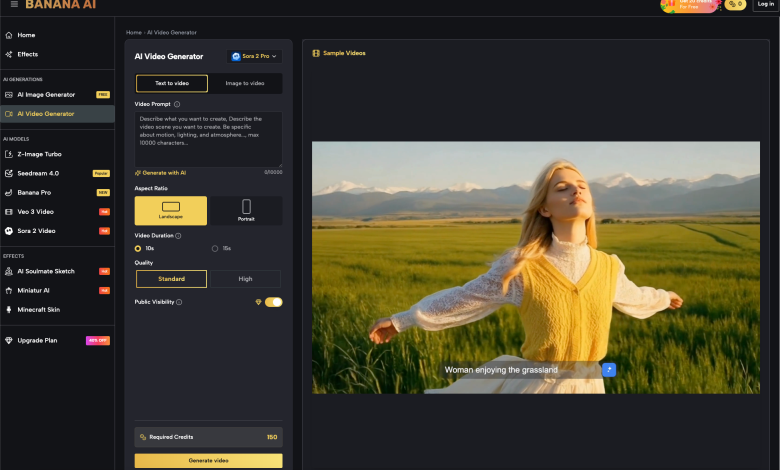
Once the static asset is perfected, the workflow moves into the video generation phase. Within the Banana AI interface, the transition involves uploading the source image and providing a motion-specific prompt. Unlike the initial image prompt, which focuses on textures, lighting, and subjects, the motion prompt should focus exclusively on physics and camera behavior.
A common mistake is re-describing the entire scene. If your source image is a woman running on a beach, you don’t need to describe the beach again; you need to describe the “wind blowing through hair” or the “slow cinematic drone track forward.”
This stage also requires careful management of the “seed” and motion strength settings. If the motion strength is too high, the AI may take too much liberty with the source image, causing the subject to morph. If it’s too low, the video looks like a static image with a slight filter. Finding the “Goldilocks zone”—usually around a 4 to 6 on a 10-point scale—is the key to maintaining the integrity of the original brand asset while adding enough life to stop the scroll.
Where Physics Fails: Navigating the Limits of Current Models
While the I2V pipeline is significantly more reliable than text-to-video, it is not without its limitations. It is important to set realistic expectations for what these models can currently achieve in a commercial context.
One major area of uncertainty is high-complexity human motion. While the AI is excellent at “cinematic” movements—slow pans, hair swaying, or steam rising from a cup—it still struggles with complex biomechanics. A video of a person performing a complex dance or a detailed hand gesture often results in limb clipping or “ghosting,” where the AI loses track of where a hand or foot should be in three-dimensional space.
Another limitation is environment warping. In scenes with complex geometric patterns, like a tiled floor or a bookshelf, the background can appear to “breathe” or shift as the camera moves. While this might be acceptable for a 5-second TikTok hook where the focus is entirely on a fast-moving subject, it would likely fail a QC check for a hero brand video on a landing page. Marketers must exercise practical judgment here: the tool is a high-speed iteration engine, not a replacement for a full-scale VFX house when pixel-perfect environmental stability is required.
Commercial Implementation: Building the High-Throughput Engine
From a business perspective, the goal of adopting an I2V workflow is to lower the cost-per-experiment. If a traditional motion designer costs $100 an hour and takes four hours to animate a series of loops, your cost-per-asset is $400. Using a generative pipeline, that same series of loops can be produced for the cost of a few platform credits and ten minutes of a junior creator’s time.
The most effective way to implement this is the “Champion-Challenger” model. You take your best-performing static image (the Champion) and use the I2V pipeline to create five different motion variations (the Challengers). You might test a “zoom-in” effect versus a “side-pan” or a “time-lapse lighting” shift.
By keeping the core visual constant and only varying the motion, you get a clean data signal on what actually drives the performance lift. Is it the product itself, or is it the specific type of movement? This level of granular testing was previously too expensive for most brands, but with a controlled image-to-video workflow, it becomes the standard operating procedure.
Future-proofing your creative team means moving away from the “one big video” mindset. Instead, teams should focus on building libraries of high-quality static assets that can be revived, animated, and re-tested across different platforms and formats at a moment’s notice. The pipeline is the product; the ads are just the output.